Here is the sequence, and if you have done this before you already know it.
You buy the thing. You spend a weekend importing contacts. For three weeks it is immaculate, and it is genuinely good. Then a deal gets busy and you update it on Friday instead of Tuesday. Then you update it when you remember. Then somebody asks where a deal stands and you check your email instead of the CRM, because your email is right and the CRM is not.
That is the moment it died. Everything after is admin.
Nobody in that story wanted a different feature.
What a CRE CRM is actually for
(Direct answer, 51 words.)
A commercial real estate CRM tracks deals, lender and borrower relationships, and the state of every active conversation, so that the answer to "where does this stand" does not live in one person's inbox. In brokerage the unit of work is the deal rather than the contact, which is why general-purpose sales CRMs fit badly.
That mismatch is worth a paragraph because it is the most common bad purchase in this category.
A sales CRM is built around a contact who moves through stages toward one transaction. A CRE deal has a property, a borrower, multiple lenders at different stages simultaneously, a document set, an underwriting model and a quote comparison, and the same lender can be at different stages on four deals at once. Force that into a contact-centric pipeline and you spend your life on workarounds. The workarounds are what you eventually stop doing.
The real evaluation criteria, in order
Not a feature list. Four questions, in the order that predicts whether you will still be using it next year.
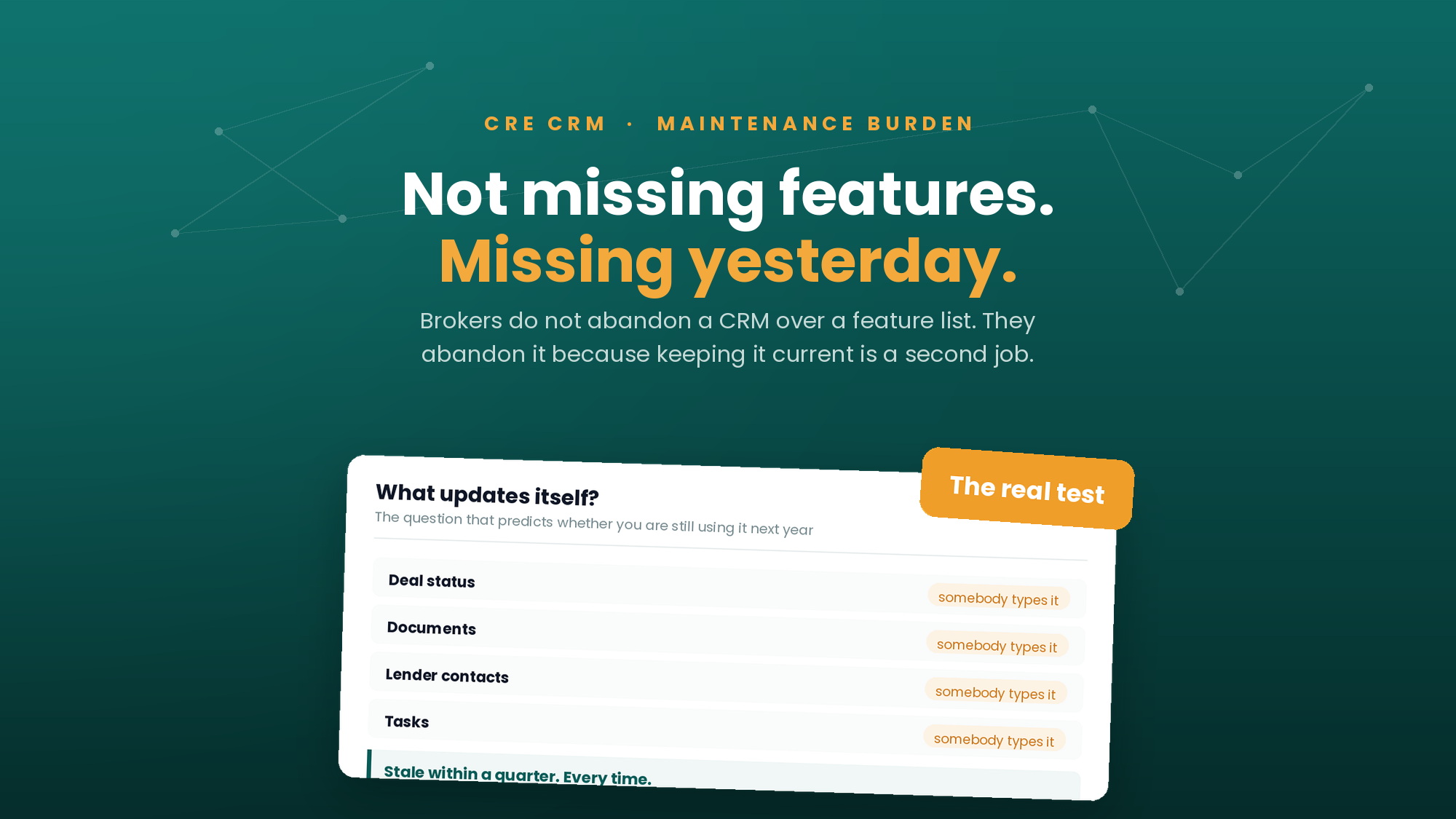
1. What updates itself? For each thing the system tracks, ask what has to happen for it to become current. If the answer is "somebody types it", assume it will be stale within a quarter. This is the only question that reliably predicts abandonment and almost nobody asks it during a demo, because during a demo the data is always perfect.
2. Where does the work actually happen? Deals move by email. Documents arrive by email. Lenders respond by email. If the system of record has no relationship with the inbox, then every update is a manual transcription from where the work happened to where the work is recorded. That is not a workflow, it is a tax, and people stop paying taxes that are not enforced.
3. Is the deal the object, or is the contact? Covered above. Look at what the URL of a single record points to. If it is a person, you are looking at a sales CRM with real estate labels.
4. What happens when it is wrong? Every automated system will misfile something. The question is whether it tells you. A system that silently guesses is more dangerous than one that keeps a short review queue, because you will trust the silent one.
Why the inbox is the whole argument
A CRE broker's real system of record is their sent folder. That is not a criticism, it is just true, and it is true for the same reason in every brokerage.
Email is where the commitment happens. A lender saying "we can look at that at 65" is the actual state change in the deal. It arrives in an inbox, and then somebody is supposed to go somewhere else and record that it happened.
Everything that goes wrong with CRMs in this industry traces back to that handoff. The information already exists in structured form, in a system you already use, at the moment it becomes true. Asking a person to copy it somewhere else is asking them to do work that a machine can see is redundant, and people are very good at noticing that.
Which is why the question to ask a vendor is not "do you integrate with email." Everyone says yes and it usually means it can send from your address. The question is what does the integration change without me typing.
What Finance Lobby does today
The deal is the object. Underwriting, the deal memo, comps and market intel, documents, lender access and competing quotes are one thing rather than six tools stitched together, which removes most of the transcription before you get to automation at all. You can build the deal memo and everything downstream inherits it.
Connecting your inbox so that documents, contacts, lenders, deal status and tasks stay current without transcription is in development. It is not live and we are not going to pretend otherwise, because an article about maintenance burden that overstates its own product would be a strange thing to publish.
When it ships you will pick which of those five it is allowed to touch, it will be read-only, and anything it is not confident about will wait for you rather than changing a deal quietly. We will say the day it is ready.
How to run the evaluation
Take whatever you are considering, including this platform, and do one thing during the trial.
Do not test it with clean data. Take a real deal that is genuinely messy, in flight, with a lender who has gone quiet and a document that arrived in the wrong format, and run that. Then leave it alone for two weeks and come back.
What you are measuring is not whether it worked. It is how wrong it got while you were not maintaining it.
That number is the only one that matters, and it is the only one no vendor will show you.