The lowest rate is frequently the most expensive quote. Comparing commercial loan terms properly means normalizing six things at once: proceeds, all-in cost including fees, prepayment structure, recourse, term and rate type, and the conditions attached to funding. A quote that wins on rate and loses on proceeds or prepayment flexibility can cost a borrower materially more over the hold.
Here is how to do that comparison, and where it usually goes wrong.
Why rate is the wrong headline
Rate is the most quoted number because it is the easiest to quote. It is also the one that tells you least about what the loan will actually cost you.
Two quotes at 6.25% are not the same loan if one funds $4.6 million and the other $5.1 million. Two quotes with identical proceeds are not the same loan if one has two points of origination and the other has half a point. Two quotes with identical pricing and proceeds are not the same loan if one carries yield maintenance and the other steps down 3-2-1, and you intend to sell in year two.
The rate is one input into cost. It is not cost.
The six things to normalize
Proceeds. Start here, not with the rate. If one lender is $500,000 short, that gap has to come from somewhere, and equity is the most expensive capital in your stack. A higher rate on a larger loan is frequently the cheaper outcome.
All-in cost, not the coupon. Origination points, exit fees, lender legal, third-party reports, extension fees. Convert everything into a single annualized cost over your realistic hold, not over the stated term.
Prepayment structure. Yield maintenance, defeasance, a step-down, a lockout, or open prepayment. This is the term that most often surprises borrowers, because it does not cost anything until the moment you need to move, and then it costs a great deal. Match it against your actual exit plan.
Recourse. Full recourse, partial, burn-off at a performance threshold, or non-recourse with standard carve-outs. This is not a pricing line, it is a personal balance sheet decision, and it is not comparable to a rate. Price the two quotes as if they were different products, because they are.
Term and rate type. A five-year fixed and a three-year floating with two extensions are different risk positions. Floating has been attractive in 2026: CBRE's James Millon described a 70 basis point spread between SOFR and the 5-year fixed rate as "too wide to ignore," with even committed fixed-rate borrowers moving to floating structures for the cost differential and prepayment optionality, while noting that rising cap costs act as a natural check. Whether that trade is right for you depends on your hold, not on the spread.
Conditions to funding. What still has to be true before this lender closes. Outstanding third-party reports, a rate lock deadline, a lease that has to be signed, committee approval that has not happened yet. A quote with four open conditions and a quote with none are not comparable, and this is where deals die quietly.
Where the comparison actually goes wrong
Not in the analysis. In the assembly.
The quotes arrive over a week, in different formats, in different inboxes. Someone rebuilds them into a spreadsheet by hand. The spreadsheet reflects whichever fields the first two quotes happened to use, so the third quote's exit fee does not have a column and ends up in a notes cell. By the time the borrower sees it, one term has been dropped and two have been rounded.
The failure is clerical, and it decides real money.
Comparing quotes on Finance Lobby
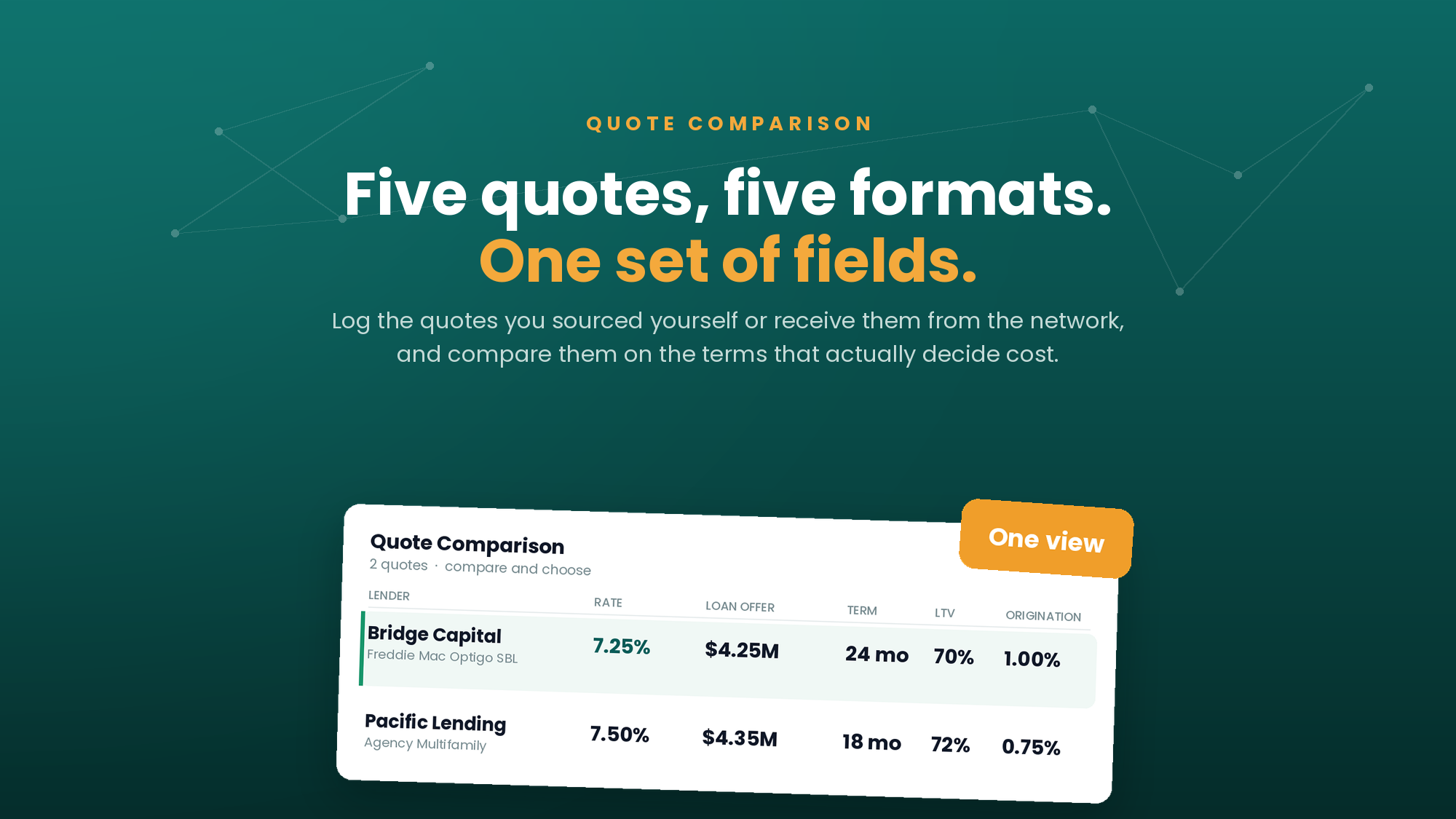
The Quote Comparison Matrix is a module inside a deal. It holds every quote on that deal in one normalized view, so the comparison is structural rather than something a person rebuilds each time.
There are two ways to fill it. You can log quotes manually, which matters because most brokers already have quotes in hand from lenders they sourced themselves, and those belong in the same comparison as anything else. Or you can post the deal to the Finance Lobby network and have quotes arrive into the matrix directly.
The second point is the one brokers tend to miss: the matrix is not only for quotes that came through the platform. A quote that arrived as a PDF attachment from a bank you have worked with for fifteen years sits in the same view, on the same fields, as everything else.
Modules: nothing generates unless you ask
The matrix is part of a broader change worth understanding, because it affects how you work.
Deal features on Finance Lobby are now modules, and nothing generates automatically. The deal memo, the underwriting worksheet, the comps report, the closing checklist, the quote matrix and tasks are each produced when you ask for them and not before.
More usefully, a module is an entry point. You can start from a single module with just an address, and get that one artifact, without building a full deal or posting anything. If all you need today is a comparison of three quotes on a property you are still deciding about, you do not have to construct a deal to get it.
Documents you upload for one module are available to every other module on that deal, so the work compounds rather than repeating.
A short checklist
Before you pick a quote:
- Rank by proceeds first, not rate.
- Convert every quote to an all-in annualized cost over your realistic hold.
- Price the prepayment structure against your actual exit, not the stated term.
- Treat recourse and non-recourse quotes as different products.
- List every open condition on each quote and ask what could still break it.
- Only then compare the rate.
FAQ
How do I compare commercial loan quotes?
Normalize six things before looking at rate: proceeds, all-in cost including all fees annualized over your realistic hold, prepayment structure, recourse, term and rate type, and outstanding conditions to funding. Rank by proceeds first, because a shortfall has to be covered by equity, which is the most expensive capital in the stack.
Is the lowest rate always the best loan quote?
No, and frequently it is the most expensive. A lower rate on smaller proceeds can force you to raise equity to fill the gap. A lower rate paired with yield maintenance can cost far more than a slightly higher rate with a step-down prepayment if you sell before maturity. Rate is one input into cost, not cost itself.
What is the most commonly missed term in a loan quote?
Prepayment structure. Yield maintenance, defeasance, lockouts and step-downs cost nothing until you need to sell or refinance early, at which point they can be the single largest expense in the loan. Conditions to funding are a close second, because they determine whether a quote can actually close.
Should I take a fixed or floating rate quote in 2026?
It depends on your hold period and exit plan rather than on the spread alone. CBRE's James Millon noted a 70 basis point spread between SOFR and the five-year fixed rate in Q2 2026 that has moved even committed fixed-rate borrowers toward floating structures, for the cost differential and the prepayment optionality, while cautioning that rising cap costs act as a natural check on that trend.
Can I compare quotes I sourced myself, outside the platform?
Yes. The Quote Comparison Matrix accepts manually logged quotes, so quotes from lenders you sourced independently sit in the same normalized view as quotes received through the Finance Lobby network.
Do I need to create a full deal to compare quotes?
No. Deal features on Finance Lobby are modules, and a module can be an entry point on its own. You can start from an address and work with a single module without building out a full deal or posting it anywhere.