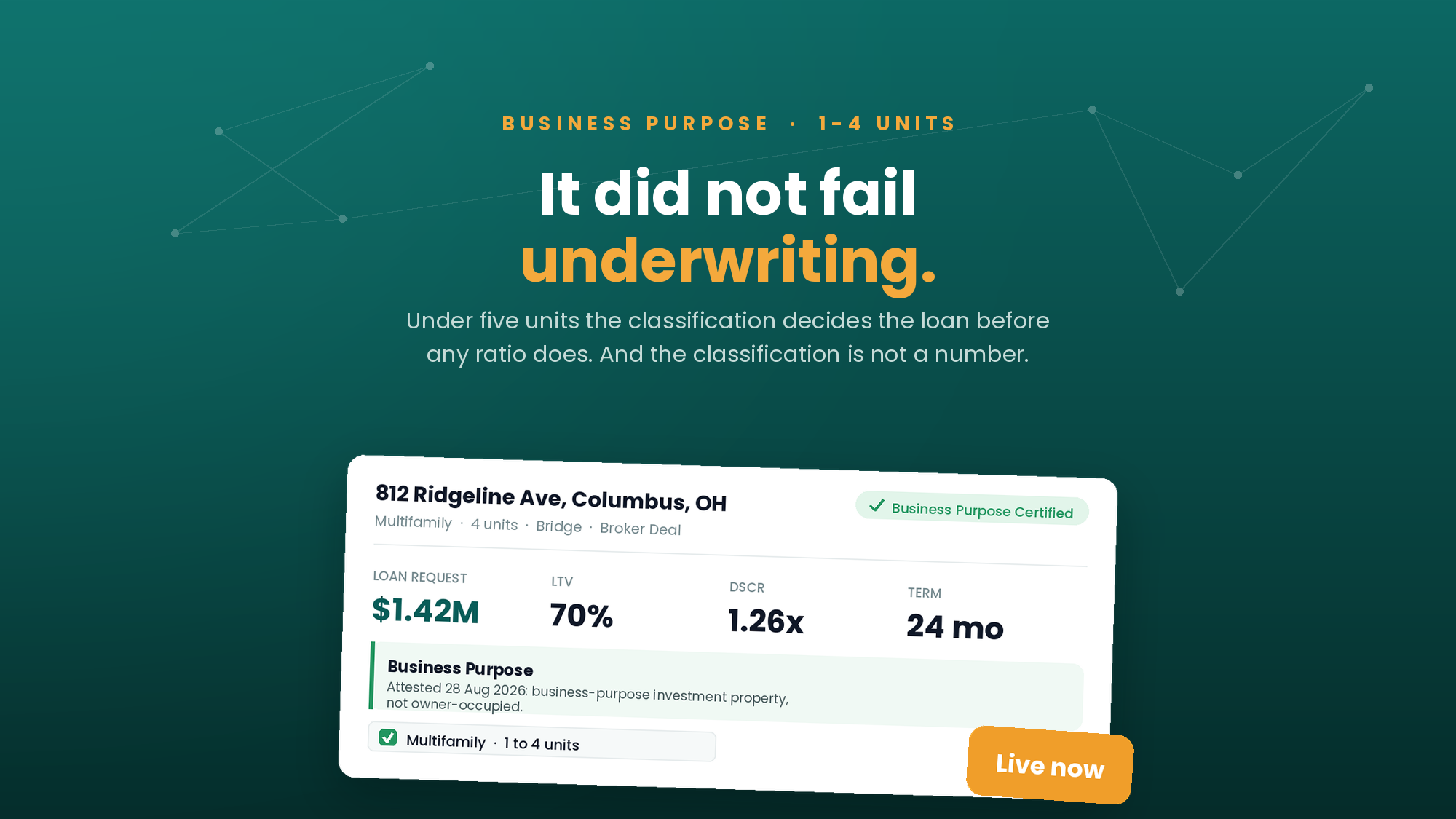
Your deal did not fail underwriting. It failed a question nobody asked.
A four unit rental. Clean rent roll, signed leases, coverage that works. It went out to eight lenders and came back with four passes, two shrugs and one long silence.
Nobody said anything about the ratios, because the ratios were fine.
What happened is that somewhere in week five a credit officer asked whether the borrower, or the borrower's family, was going to live in one of the units. The answer was yes. And in that moment the file stopped being a commercial loan application and became something the lender is not set up to originate.
That question had an answer on day one. It just never travelled with the deal.
What a business purpose loan actually is
(Direct answer, 54 words.)
A business purpose loan is credit extended primarily for a business, commercial or investment purpose rather than for personal, family or household use. That distinction is what exempts the loan from the federal consumer mortgage rules. It depends on how the property is used, not on the property type, the loan size, or the number of units.
The exemption is not a loophole. Regulation Z has carried it since it was written, and it is the basis on which the entire investment property lending market operates. A lender writing a loan against a stabilised apartment building is not running ability-to-repay analysis on the owner's household income, and nobody thinks they should be.
Where it gets genuinely hard is the bottom of the range.
Above five units nobody argues. Below five, the same building is two different loans.
At five units and up, a multifamily property is an income property. The loan is a business loan, the analysis is commercial, and the question never comes up.
At one to four units, the same building can be either thing depending on facts that are invisible from the outside:
- Will the borrower occupy one of the units
- Is a tenant a relative, and if so are they paying market rent
- Was the property bought to hold and rent, or was it bought to live in and the rental income is incidental
- Is this the borrower's second attempt to finance a home purchase in commercial clothing
Get those wrong in the lender's favour and nothing happens. Get them wrong in the other direction and the loan is subject to TILA, RESPA, the ability-to-repay rule and the loan originator compensation rules. It is a different product, originated by differently licensed people, with a different file.
Which is why so many small-balance lenders quietly stopped taking the asset class. Not because the deals were bad. Because they could not tell which was which without asking, and asking costs money on every deal including the clean ones.
The tax that clean deals pay for ambiguous ones
This is the part that should annoy anyone placing small multifamily.
A lender scanning a pipeline sees a four unit deal and cannot distinguish a professionally held rental from a house purchase wearing a commercial coat. Both look identical on the card. So the rational response is not to underwrite carefully, it is to skip the category and spend the same hour on a twenty unit deal where the question does not arise.
The cost of ambiguity is not paid by the ambiguous deals. They were never getting financed anyway. It is paid by the clean ones, which get sorted into the same pile and passed over with them.
That is a market failure with a very boring fix: move the fact to where the reader is.
What changed on Finance Lobby
Two things, and the second one is the one lenders care about.
A 1-4 unit multifamily deal cannot be published until it is confirmed as business purpose. Not a warning and not a note in the file. The publish button stays disabled until the box is ticked, and the refusal is enforced on the server, so it holds across the deal form, the Underwriting Sheet, republish, private and selected-lender publish, and admin approval.
The trigger is property type and unit count only. It does not depend on the loan program, so a four unit deal on a bridge or a construction loan is treated exactly like one on DSCR. Five units and up is untouched, because above the line there is no question to ask.
Ticking the box writes a record against the deal that cannot be edited: who confirmed, when, and which version of the wording they agreed to. The wording is versioned rather than overwritten, so if the language is ever revised, older deals keep the sentence the broker was actually shown. An attestation you cannot reconstruct is not much of an attestation.
And lenders can now say whether they want these deals at all. Multifamily used to be one box in lending preferences. A credit union writing four unit rental paper at $1.4 million and an agency shop writing a 300 unit community at $60 million both ticked the same box, so both received each other's deals every week, and both learned to stop opening the notifications. One to four units is now its own setting inside Multifamily, on or off, independent of everything else.
What a lender sees on a certified deal
- A green Business Purpose Certified pill on the deal card in the pipeline list, so it reads without opening anything
- The same badge on the deal page, with a Business Purpose row carrying the full sentence: who attested, on what date, that the property is a business-purpose investment and not owner-occupied, and that related-party tenants must lease at market rent
- A filter, Business purpose certified only, which turns the category from a judgment call into a search
The related-party condition is the part worth reading twice. It is the most common way a genuinely well-intentioned deal turns out not to qualify, and stating it in the attestation puts it in front of the person who has the facts at the moment they are confirming.
What this does not do
A certification is a representation by the broker. It is not a legal opinion, it is not underwriting, and it does not move the lender's own diligence obligation anywhere. What the platform does is record what was said, by whom, and when, in a form that survives a servicing transfer. What a lender does with that record stays a credit and compliance decision.
It also does not change the ratios. Once the classification is settled, the deal still has to work, and that is where coverage comes back in. If you want the arithmetic, the DSCR guide covers how lenders calculate it and where the thresholds sit, and DSCR requirements by property type covers how those thresholds move by asset.
What to do with this
If you place small multifamily, the change to your workflow is one confirmation before publish. Deals you published before the change are unaffected unless you republish. Underwrite it, build the deal memo, publish, confirm.
If you write small-balance rental paper, open your lending preferences, set one to four units the way you actually want it, and then set the certified filter. Then go back and look at the deals you have been passing over, because some meaningful share of them were never the problem. You can also drop your lending preferences so the deals that fit your box are the ones that reach you.
The question was always going to be asked. Asking it at the top costs one click. Asking it in week five costs the deal.